Pet medical equipment
DRT-40Vet Vet Static DR Radiography Imaging System
DRT-40Vet Vet Static DR Radiography Imaging System
Request a Quote
Tell us the quantity and destination — we reply with a proforma invoice and payment details. We accept USD bank transfer (T/T), ACH and wire.
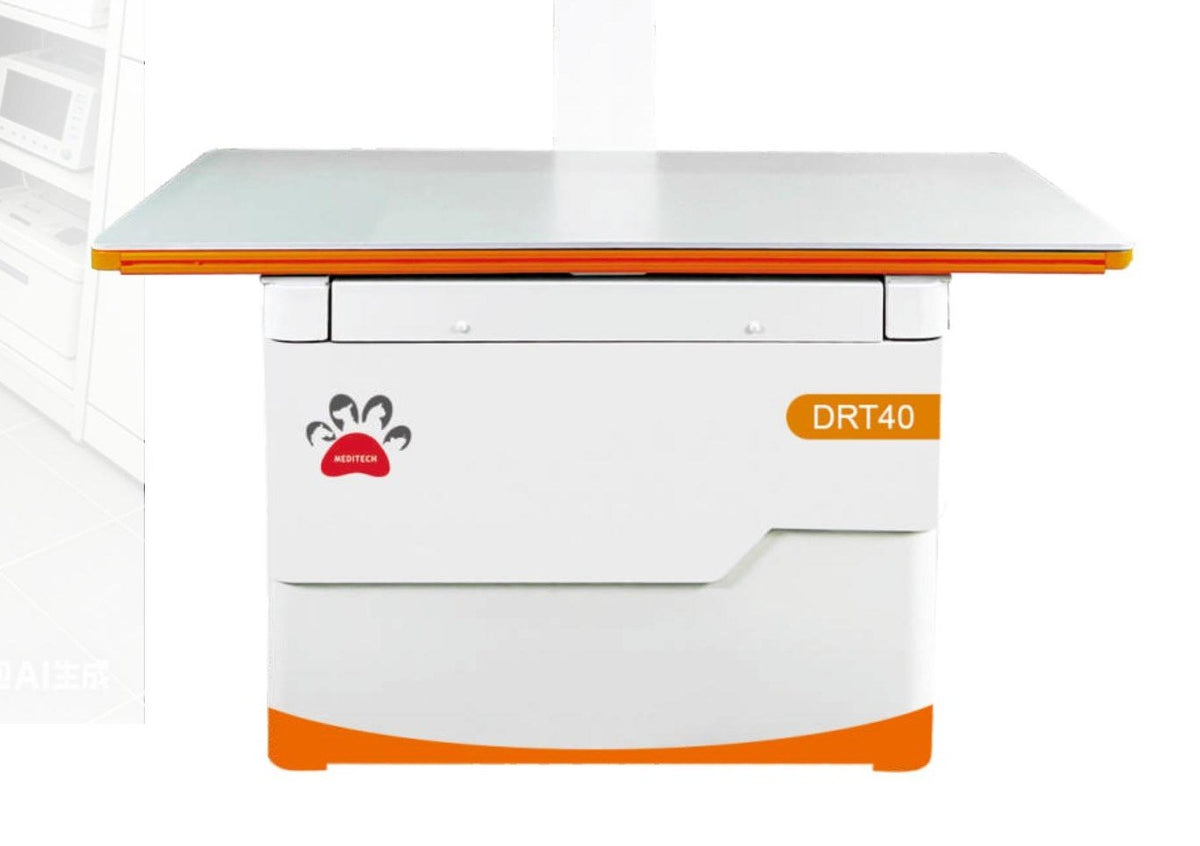
Chat on WhatsApp — instant replyThe DRT-40Vet is a veterinary static DR system built around a Canon rotating anode tube, a 32kW generator and a four-way floating table. It's a veterinary digital radiography machine and nothing more — which is exactly why it costs less than a multi-mode imaging system and takes up less of your building.
PetMedTools supplies it quote-first. Tell us the destination country and expected quantity and we'll come back with a formal quotation and proforma invoice.
The tube is the part that decides everything
A Canon rotating anode tube sits at the centre of this system. Rotating anode matters because it spreads heat across a moving track instead of hammering one spot on a stationary target. That's what allows repeated exposures through a busy morning without waiting for cooling.
Focus spot options are 1.0mm and 2.0mm. Maximum tube voltage is 125kV. The smaller focal spot gives sharper detail for extremity and dental-adjacent work; the larger one carries more load for thicker body parts. Having both is the point.
32kW and the five-second exposure
The high voltage generator runs 110/220V at 32kW and 400mA, and supports exposure in 5 seconds. Generator power is what lets you use short exposure times, and short exposure times are what freeze motion in a patient who won't hold still.
Ask any nurse who has radiographed a panting bulldog. The difference between a diagnostic film and a repeat isn't usually technique — it's whether the exposure finished before the chest moved.
Detector specification
The flat panel detector has a 17"*17" active area with 139um pixel pitch and 3.6lp/mm spatial resolution. A 17x17 panel covers most small animal work in a single exposure, including thorax on medium and large breeds.
Pixel pitch and line pairs per millimetre are the two numbers that describe how much detail survives to your screen. At 139um and 3.6lp/mm you're in normal territory for veterinary DR — good enough for orthopaedic assessment and foreign body work, and the practical limit is more often positioning than panel resolution.
Four-way floating table
The table floats in four directions. This sounds minor on a spec sheet and turns out to be the thing your team comments on most. Repositioning a sedated patient is heavy, awkward work. Moving the table instead of the animal is faster, safer for staff backs, and reduces the number of times you disturb a carefully arranged limb.
Display and workstation
A 22" touch screen pairs with a 24" monitor in synchronous display, driven by the acquisition workstation. Two screens means the person operating can drive the study while a second person reviews, which matters during a trauma case when decisions are being made in real time.
Specifications
- X-ray tube: CANON rotating anode tube
- Focus spot: 1.0/2.0mm
- Max tube voltage: 125kV
- High voltage generator: 110/220V, 32kW, 400mA
- Exposure: supported in 5s
- Flat panel detector active area: 17"*17"
- Pixel pitch: 139um
- Spatial resolution: 3.6lp/mm
- Table: four-way floating
- Display: 22" touch screen + 24" monitor, synchronous
What a 17x17 panel does and doesn't cover
A 17"*17" active area handles thorax and abdomen in one exposure for cats, small dogs and most medium breeds. On a large or giant breed you're into two-view stitching for a full abdominal series, and on a Great Dane thorax you will be positioning deliberately rather than centring casually.
That isn't a fault in the panel — it's the standard trade-off at this size. It's worth knowing before purchase because it changes your technique sheets, not your satisfaction with the machine. Practices with a heavy large-breed or equine-adjacent caseload should raise it at quotation and we'll confirm what alternatives exist.
The costs that don't appear on the quotation
The machine is one line item. The room around it is several.
Lead protection for staff, dosimetry badges and their ongoing service, positioning aids, sandbags and troughs, grid selection if your technique calls for it, and the shielding work on the room itself. None of these are exotic and all of them are easy to leave out of a budget built around the equipment price.
Ask us for the full installation requirement early. It's a short conversation that prevents a long delay.
Where it sits against fluoroscopy and CT
Static DR gives you stills. That covers the overwhelming majority of a general practice caseload — chest, abdomen, limbs, survey films, post-op checks.
If you need to watch something move, the DRT-META32 fluoroscopy DR is the sibling to price instead. It runs 32kW input power, kV range 40-150kV, mA from 0.5-400mA depending on mode, and exposure from 0.001-20s for stills up to five minutes of continuous fluoroscopy. Swallow studies and contrast transit need that; a fractured radius does not.
If you need cross-sectional imaging, the Vetist 3 CBCT covers CT, dynamic DR, static DR and dental panoramic in one gantry at 4.5 seconds per scan. It costs more and needs a room. Our veterinary diagnostic equipment buying guide works through where each line falls, and the diagnosis and imaging range shows what else is available.
Planning around the purchase
Radiography on a conscious patient is possible for some views and impossible for others. Sedation protocols drive equipment choice more than most buyers expect — the veterinary anesthesia machine buying guide and the veterinary patient monitor buying guide cover what you need beside the table.
Dental radiography is a separate workflow with separate kit, and the veterinary dental equipment buying guide explains why a chairside sensor doesn't replace a DR table or vice versa. Chairside options are in the dental X-ray and sensor category.
For oxygen supply during sedated imaging see the veterinary oxygen equipment buying guide, and the full index sits at the buying guides hub.
What to confirm before you order
The DRT-40Vet is manufactured by TooToo MediTech Co., Ltd. Everything above is from the manufacturer's published specification. Four things it can't answer:
Room and shielding. Radiography rooms carry legal shielding requirements that differ by country and sometimes by region. Sort this before ordering, not after.
Power supply. A 32kW generator has real electrical requirements. Confirm your supply against the installation specification before the order is placed.
Market registration. Tell us your destination country so we can confirm what documentation ships with the unit.
Service and warranty. Ask for warranty length, service arrangements and tube coverage in writing alongside the quotation. Tube replacement is the big lifetime cost on any X-ray system — know the terms before you pay.
Buying a DRT-40Vet
We work quote-first, so there's no price on this page. Send the models you're comparing, expected quantity, destination country and any certification, accessory or packaging requirements. We issue a proforma invoice against that, payment is by USD bank transfer — T/T, ACH or wire — and we ship once it clears.
Bulk pricing, distributor terms, OEM questions, region limits and shipping review are all settled at quotation. Still comparing categories? Start from the full product range.
One request that saves everyone time: send your room dimensions and a note on your typical patient sizes with the enquiry. Those two details let us tell you straight away whether this is the right system for you or whether you should be looking at a different tier — and we'd rather tell you that before you commit than after the crate lands.