Pet medical equipment
DTS-280 Veterinary Dental Workstation
DTS-280 Veterinary Dental Workstation
Request a Quote
Tell us the quantity and destination — we reply with a proforma invoice and payment details. We accept USD bank transfer (T/T), ACH and wire.
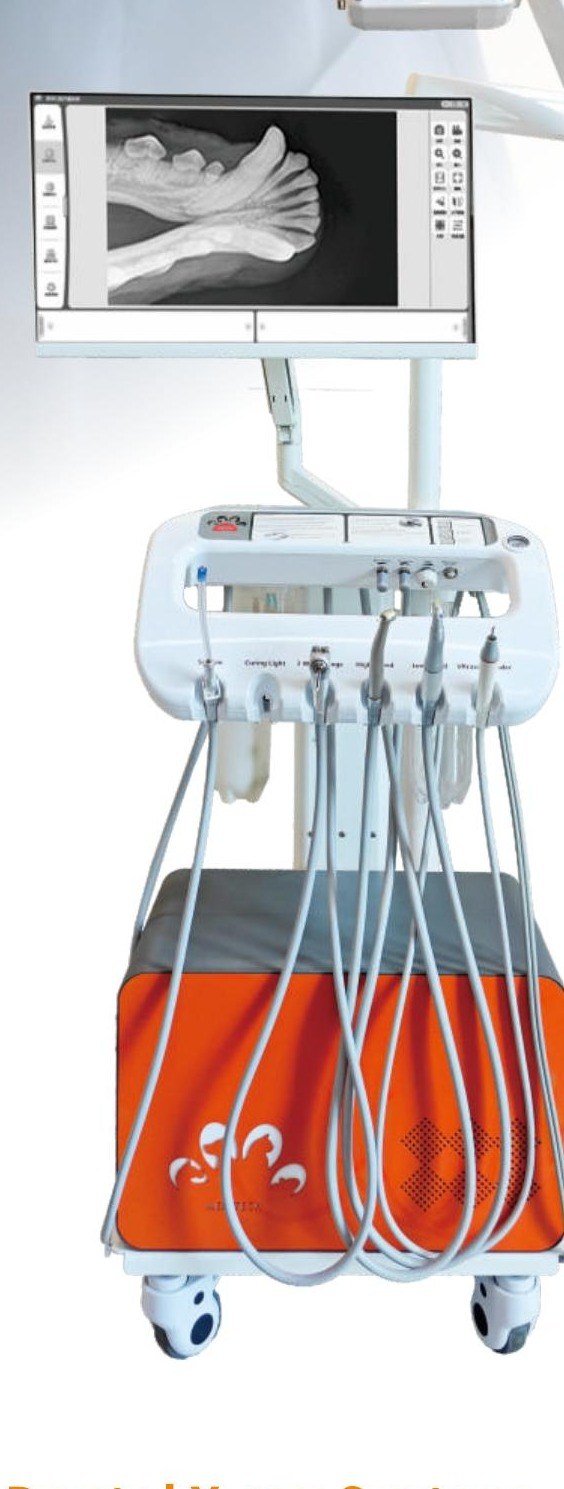
Chat on WhatsApp — instant replyThe DTS-280 is an all-in-one veterinary dental workstation: dental unit, X-ray system, oral camera and touch screen displays in a single machine. The portable X-ray runs on lithium battery with wireless shooting, mounted on an arm that rotates through 180 degrees and holds position anywhere in the air.
PetMedTools supplies this veterinary dental workstation quote-first. Tell us your destination country and expected quantity and we'll issue a formal quotation with a proforma invoice.
What all-in-one actually means here
Plenty of equipment gets called all-in-one. In this case the claim is specific: dental unit, X-ray system, oral camera and touch screen displays, with two software systems — one for the X-ray, one for the oral camera.
The integrated functions cover X-ray shooting, saliva suction, cleaning, grinding, polishing and cutting. The unit can be upgraded to a disinfectant system.
Why does integration matter beyond tidiness? Because the alternative is three separate purchases with three separate footprints, three power leads, and images landing in three places. In a dental room that's usually a converted prep area, floor space is the binding constraint.
The 180° rotating arm
Arm length is 80cm*2 and it rotates through 180 degrees, hovering at any angle in the air.
Dental radiography demands specific tube angles for each tooth position — the parallel and bisecting angle techniques both require putting the tube where the anatomy dictates rather than where the equipment allows. An arm that holds position anywhere means you move the tube to the patient instead of repositioning an anaesthetised animal for every view.
Over a full mouth series that's ten to fourteen repositioning events avoided. On an anaesthetised patient, that's real minutes.
The portable X-ray
The X-ray machine runs on lithium battery with wireless shooting, so there's no cable tethering it to the unit.
Specifications: tube voltage 65kV fixed, tube current 2mA fixed, tube focal 0.4mm, oil cooling, inherent filtration 0.8mm Al, target angle 12.5°, time set-up 0.05~1.35 sec including film and digital, SID +10cm fixed, X-ray field 50mm round-style. It measures 175.6 x 149 x 150.3mm and weighs 1.7kg excluding battery.
The battery runs 12V ~ 16.8V DC with power at max 240W/20A, operating between 0 and 40°C.
Fixed 65kV and 2mA means you control exposure through time alone, across a 0.05 to 1.35 second range. That's the standard approach for veterinary dental and it works well once your technique chart is built. If you want adjustable kV, the TT-52DX portable unit offers 60/65/70kV at 2.5 or 3.5mA instead.
The DTS-280 plus
The manufacturer also lists a DTS-280 plus with a Smart Ray dental X-ray machine and a different specification: 3.5" touch screen with simplified UI, tube voltage 70kV, tube current 2mA, focal spot 0.4mm, inherent filtration 1.0mmAl, target angle 12°, loading time 0.02-2s, SID 20~23cm, X-ray field Φ5.9cm, dimensions 240 x 161 x 143mm, weight 2.2KG. Its battery charges in about an hour at 48W and is quoted at 500+ shots on a full charge.
The plus configuration also carries a 23.8 inch touch screen PC with built-in WiFi and Bluetooth running both the dental X-ray and oral camera software, plus an intraoral sensor.
Higher kV, longer loading time range, larger screen. Whether that justifies the difference depends on your caseload — ask us to price both.
Specifications
- Portable X-ray tube voltage: 65kV (fixed)
- Portable X-ray tube current: 2mA (fixed)
- Tube focal: 0.4mm
- Cooling system: oil cooling
- Inherent filtration: 0.8mm Al
- Target angle: 12.5°
- Time set-up function: 0.05~1.35 sec (film/digital included)
- SID: +10cm (fixed)
- X-ray field: 50mm (round-style)
- Size (L*W*H): 175.6 x 149 x 150.3 mm
- Net weight: 1.7 kg (excluding battery)
- Lithium battery power: max 240W/20A
- Lithium battery voltage: 12V ~ 16.8V DC
- Battery temperature range: 0~40°C
- Rotating arm: 180°, arm length 80cm*2
Two software systems and where images live
The unit runs separate software for the X-ray system and the oral camera. Both matter clinically and they do different jobs — radiographs show root and bone, the oral camera shows crown, gingiva and calculus.
The oral camera is also the client communication tool. An owner who has been told their dog needs eight extractions responds differently once they've seen the mouth on screen.
One question to settle before purchase: how do images get out of the system and into your practice management software or a referral email? Ask us at quotation. An imaging system that can't export cleanly creates a records problem that only becomes obvious months later.
DTS-280, DTS-P302 or DTS-180?
DTS-180 is the entry system — oil free air compressor at 550W and 2.4A, 70L/min airflow, 0.8Mpa exhaust pressure, under 60dB, LED ultrasonic scaler handpiece, upgradeable disinfectant system. Scaling and polishing, no imaging.
DTS-P302 is the electric motor unit with four gear ratios from 16:1 through 1:5 speed increasing, including the reduction ratios root canal work requires.
DTS-280 is this unit: imaging built in, arm mounted, two software systems.
The honest summary — buy the 180 for scaling, the P302 for endodontics, the 280 for imaging. Our veterinary dental equipment buying guide works through the decision in more detail.
Battery discipline on a wireless X-ray
Wireless shooting is genuinely better than dragging a cable around a dental table. It also introduces a failure mode that cabled equipment doesn't have: the battery goes flat halfway through a full mouth series, on an anaesthetised patient.
A full series is ten views in a cat and closer to fourteen in a dog. Work out how many series you get per charge, then build the charging routine around that number — charge overnight, keep a spare battery, and check the level before induction rather than before the first exposure.
The battery operates between 0 and 40°C, which is worth noting if your dental room gets cold overnight or your equipment is stored somewhere unheated. Lithium cells lose capacity in the cold and the loss shows up as fewer shots per charge rather than as an obvious fault.
Building the dental service
Dentals are long, low-stimulation anaesthetics where hypothermia is the main risk. The veterinary anesthesia machine buying guide and veterinary patient monitor buying guide cover matching equipment to that profile.
Sensors and additional imaging options sit in the dental X-ray and sensor category. Instruments and burs are in dental instruments and sets, scaler tips in the dental ultrasonic scaler range, consumables in dental consumables, and sterilisation in dental sterilisation. The veterinary dental accessories buying guide and the buying guides hub cover the rest.
What to confirm before you order
The DTS-280 is manufactured by TooToo MediTech Co., Ltd. Everything above comes from the manufacturer's published specification. Four things to settle at quotation:
Standard or plus. Different X-ray specification, different screen, different price. Decide before ordering.
Sensor. Confirm which sensor is included and whether it suits the patient sizes you see.
Image export. Ask how images leave the system. Get the answer before payment.
Radiography regulations. Room and operator requirements vary by country. Confirm what applies to you.
Buying a DTS-280
We work quote-first, so there's no price on this page. Send the models you're comparing, expected quantity, destination country and any certification, accessory or packaging requirements. We issue a proforma invoice against that, payment is by USD bank transfer — T/T, ACH or wire — and we ship once it clears.
Comparing across categories? Start from the full product range.