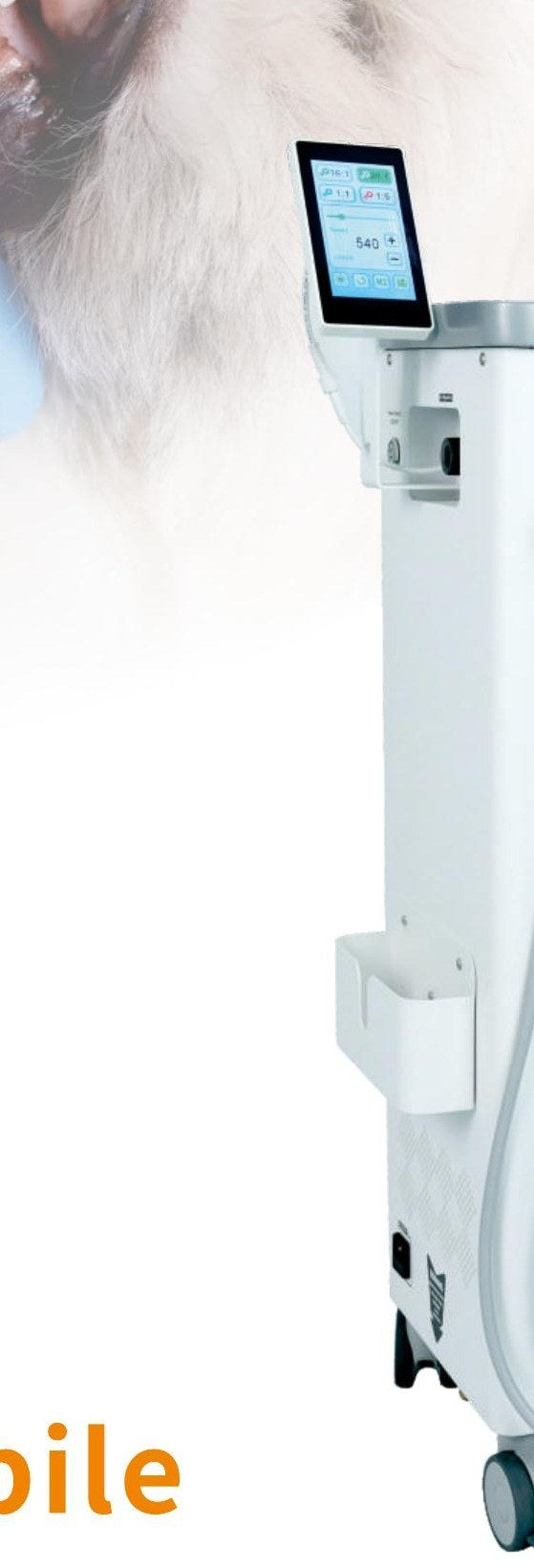
Pet medical equipment
DTS-P302 Veterinary Mobile Dental Workstation
DTS-P302 Veterinary Mobile Dental Workstation
Request a Quote
Tell us the quantity and destination — we reply with a proforma invoice and payment details. We accept USD bank transfer (T/T), ACH and wire.
Chat on WhatsApp — instant replyThe DTS-P302 is a veterinary mobile dental workstation driven by an electric motor rather than an air turbine. More stable speed, quieter operation, and a low-speed handpiece with four selectable gear ratios — including the reduction ratios that root canal work actually requires.
PetMedTools supplies this veterinary dental unit quote-first. Tell us your destination country and expected quantity and we'll issue a formal quotation with a proforma invoice.
Electric motor versus air turbine
Most veterinary dental units drive the low-speed handpiece with compressed air. Air is simple and cheap, and it has one significant weakness: torque collapses under load. Push an air-driven bur into dense bone and the speed drops exactly when you need it not to.
An electric motor holds speed under load. For polishing and sectioning that means consistent cutting rather than stalling and surging, and consistency is what protects both the tooth and the operator's patience.
The manufacturer also cites longer service life and quieter operation, and notes that it reduces fatigue during extended work. Anyone who has done a four-hour dental knows that noise and vibration are cumulative.
Four gear ratios and why two of them exist
The electric motor offers four speed settings on the low-speed handpiece:
- 16:1 — 150-2500 RPM
- 20:1 — 100-2000 RPM
- 1:1 — 2000-40000 RPM
- 1:5 speed increasing — 10000-200000 RPM
The manufacturer states that 16:1 and 20:1 are mainly for root canal treatment. Those are reduction ratios — the handpiece turns slower than the motor, and the trade is torque.
Endodontic files break when driven too fast, and a fractured file inside a root canal is a genuinely bad afternoon. Low speed with high torque is the correct configuration, and a unit without reduction ratios simply cannot do endodontics safely. If root canal work is on your roadmap, this specification is the reason to buy this unit rather than a cheaper one.
At the other end, 1:5 speed increasing reaches 200,000 RPM for fine cutting where you want speed rather than force.
What's integrated
The unit combines X-ray shooting, saliva suction, LED curing light, cleaning, grinding, polishing and cutting.
Component detail worth knowing: the low-speed handpiece for polishing runs at 15,000-20,000rpm with inner water spray at 0.15-0.25MPa working pressure. The high-speed handpiece for cutting has an LED light and runs 320,000-400,000rpm. The 3-way syringe delivers water, air and mist. The detachable LED scaler outputs 3W-20W at 0.01Mpa-0.5Mpa water pressure, and the suction handpiece clears saliva and waste water from the mouth.
A note on one figure: the low-speed handpiece callout states 15,000-20,000rpm while the specification table lists the low speed hand piece at 20,000-40,000rpm. Both appear in the manufacturer's own catalogue. We've reproduced both rather than picking one, and we'd suggest confirming which applies to your configuration at quotation.
Specifications
- Air compressor power/current: 220V:550W/2.5A, 110V:550W/5A
- Air compressor output pressure: 0.8MPa
- Air tank capacity: 10L
- Ultrasonic scaler power: 3-20W
- Ultrasonic scaler working pressure: 0.01-0.5MPa
- Vibration frequency on tips: 28kHz±3kHz
- High speed hand piece: 320,000-400,000rpm at 0.3-0.35MPa
- Low speed hand piece: 20,000-40,000rpm at 0.15-0.20MPa
- Noise (air supply process only): 65dB
- LED scaler: 3W-20W output, 0.01Mpa-0.5Mpa water pressure
The 10L tank and 65dB
Tank capacity determines how long the compressor stays quiet. A small tank means the motor cycles constantly; 10L gives you a working reservoir so the compressor runs less often.
65dB is quoted specifically for the air supply process, and it's roughly conversation level. That matters in a practice where the dental table isn't in a soundproofed room — which is most practices. Noise drives owner perception and staff fatigue in equal measure.
The mobile part
This is a mobile workstation on castors with a foot control. Mobility suits practices where dentals happen wherever there's space, or where one unit serves two rooms.
Two practical cautions. Cables and foot pedals are the components that fail on mobile equipment, because they get rolled over and yanked. And a unit that moves needs somewhere to live between cases — decide that before it arrives, or it ends up parked wherever it was last used.
DTS-P302, DTS-280 or DTS-180?
Three units, three different answers.
DTS-180 is the entry system: oil free air compressor at 550W and 2.4A, 70L/min airflow, 0.8Mpa exhaust pressure, under 60dB, with an LED-illuminated ultrasonic scaler handpiece and an upgradeable disinfectant system. Scaling, polishing and extraction, no imaging.
DTS-P302 adds the electric motor with its four gear ratios and the imaging cart option. This is the endodontics-capable unit.
DTS-280 is the all-in-one: dental unit, X-ray system, oral camera and touch screen displays with two software systems, plus a 180° rotating arm with 80cm*2 arm length and a portable lithium-battery X-ray machine for wireless shooting.
Our veterinary dental equipment buying guide works through that decision, and the veterinary dental accessories buying guide covers what you need alongside whichever you choose.
Water in, water out
The specification covers what the machine does. It doesn't cover the two plumbing decisions that determine whether installation takes an hour or a week.
Water in: the handpieces and scaler need a supply. Self-contained bottle systems give you control over water quality and let you run disinfectant through the lines. Mains-fed systems are less work day to day and less controllable. Bottle systems are generally preferred in veterinary settings for exactly the biofilm reasons that make the disinfectant upgrade worth considering.
Water out: suction has to go somewhere, and dental waste carries tissue debris and calculus. Whatever collection or drainage arrangement you choose needs emptying and cleaning on a schedule, and it needs a person assigned to it.
Neither of these is difficult. Both are easier decided before delivery than discovered on the day.
Building the dental service
Every dental happens under anaesthesia, and dentals run long. The veterinary anesthesia machine buying guide and veterinary patient monitor buying guide cover matching those to long low-stimulation procedures where hypothermia is the main risk.
Radiography is not optional in modern veterinary dentistry — the dental X-ray and sensor category lists options if your unit doesn't include imaging. Instruments and burs sit in dental instruments and sets, scaler tips in the dental ultrasonic scaler range, consumables in dental consumables, and sterilisation in dental sterilisation. The index is at the buying guides hub.
What to confirm before you order
The DTS-P302 is manufactured by TooToo MediTech Co., Ltd. Everything above comes from the manufacturer's published specification. Four things to settle at quotation:
Voltage. The compressor is specified for both 220V and 110V. Confirm which you're being quoted.
Low speed handpiece figures. The catalogue prints two different ranges. Get the one that applies to your unit in writing.
Handpiece and bur stock. Handpieces are consumable over a few years and burs over a few months. Order spares with the unit.
Service and warranty. Get warranty length and service arrangements on paper alongside the quotation.
Buying a DTS-P302
We work quote-first, so there's no price on this page. Send the models you're comparing, expected quantity, destination country and any certification, accessory or packaging requirements. We issue a proforma invoice against that, payment is by USD bank transfer — T/T, ACH or wire — and we ship once it clears.
Tell us whether endodontics is part of your plan. That single answer determines which of the three dental units you should be pricing. Comparing across categories? Start from the full product range.