Pet medical equipment
TooLas Veterinary Laser Therapy Device
TooLas Veterinary Laser Therapy Device
Request a Quote
Tell us the quantity and destination — we reply with a proforma invoice and payment details. We accept USD bank transfer (T/T), ACH and wire.
Chat on WhatsApp — instant replyThe TooLas is a Class IV veterinary laser therapy device for photobiomodulation. Class IV is the specification that matters here — the manufacturer states it reduces treatment time by nearly 30 times compared with Class IIIb lasers, which is the difference between a therapy service you can staff and one you can't.
PetMedTools supplies this veterinary laser therapy unit quote-first. Tell us your destination country and expected quantity and we'll issue a formal quotation with a proforma invoice.
Why treatment time decides whether this pays
Photobiomodulation works by delivering a dose of light energy to tissue. Dose is power multiplied by time. A lower-power device doesn't deliver a smaller dose — it delivers the same dose over a longer period.
That's a clinical equivalence and a commercial chasm. A treatment that takes 4 minutes fits between consults. The same treatment at 30 times the duration does not fit anywhere in a working day, which is why so many Class IIIb units end up in a cupboard within a year of purchase.
If you're evaluating laser therapy as a revenue line rather than an occasional extra, treatment time is the number to interrogate first.
The four dosage variables
The manufacturer sets out what determines effective photobiomodulation dosage: wavelength, irradiance (power density, sometimes expressed as brightness), pulse, and exposure time. Safe and effective treatment has to account for all four rather than turning the power up.
Treatment depth depends on wavelength, irradiance and power and spot size, energy delivery mode, and contact versus non-contact application. Treatment time itself depends on treatment area size and tissue type — nerves, joints and muscles absorb differently.
High-energy devices don't just deliver more power. They allow larger spot sizes, which makes it easier to deliver adequate doses across larger treatment areas. That's the practical argument for Class IV on a large dog's hip or lumbar spine.
What it's used for
The stated effects are enhanced immunity, repair of cellular inflammation, rapid pain relief and tissue regeneration.
Tissue coverage is broad: nerves, muscles, skin, tendons, ligaments and joint capsules. Species coverage is broader than most practices expect — dogs, cats, horses, rabbits, snakes, birds, turtles and lizards are all listed.
The exotics coverage is worth pausing on. Laser therapy is non-contact and doesn't require restraint or sedation for most applications, which makes it usable on species where almost every other therapeutic intervention involves a difficult handling decision.
The interface
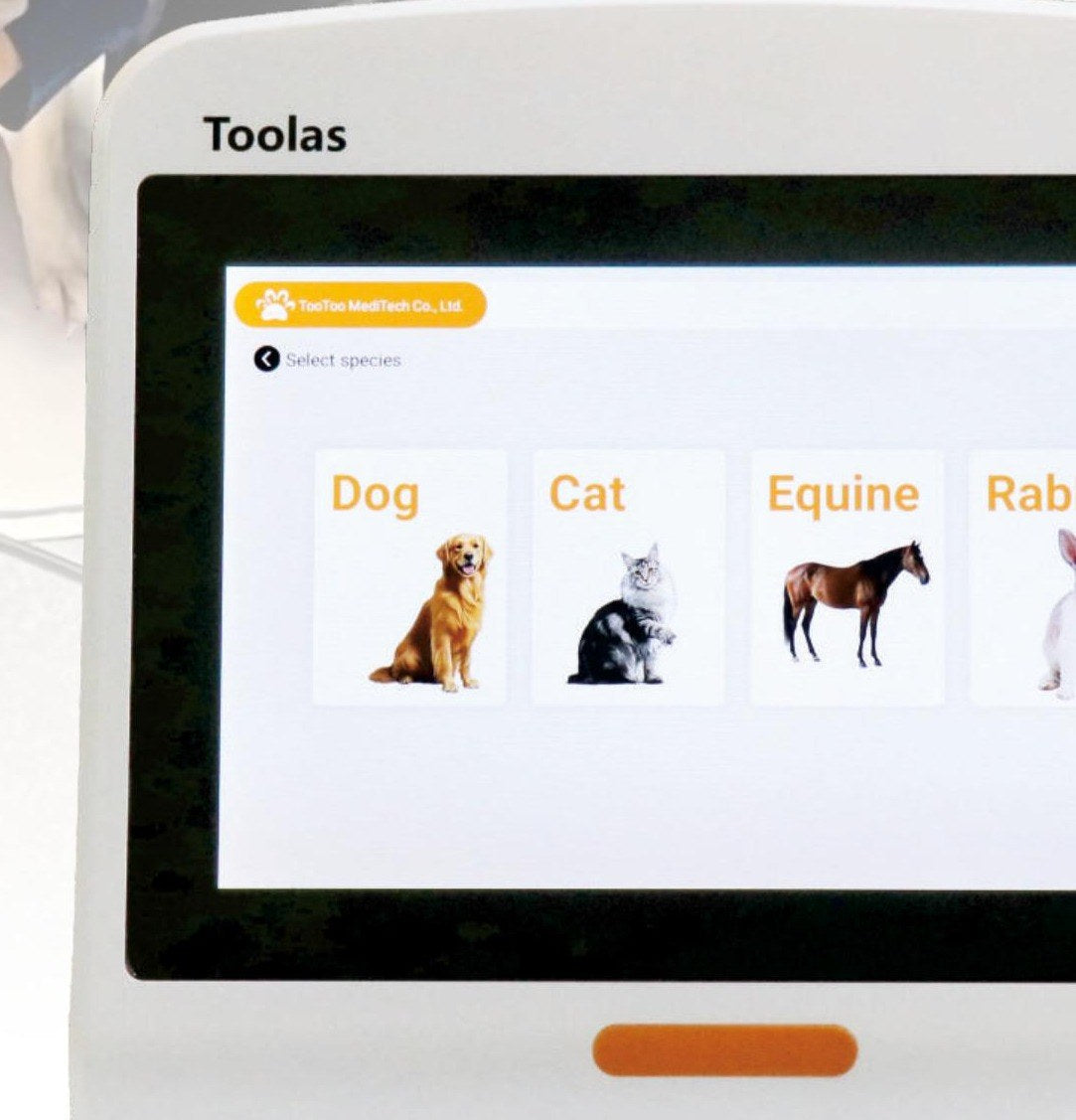
The 10.1-inch touchscreen at 1280 x 800 pixels presents species selection directly — dog, cat, equine, rabbit — with protocols behind each.
Why does that matter? Because laser therapy is usually delegated to nurses and technicians, and a device that requires calculating dosage per case from first principles gets used inconsistently or not at all. Species-first navigation is a workflow decision disguised as a UI choice.
Specifications
- Touchscreen: 10.1-inch, 1280 × 800 pixel
- Sound pressure level: 50-75 dB
- Size: 25 cm (L) × 28 cm (W) × 28 cm (H)
- Weight: 4.1 kg (main unit)
- Input voltage: 100-240VAC, 50/60Hz, 150W, 12DC
- Output voltage: ≤10A
- Laser class: Class IV
One note on that specification table: the manufacturer prints "Output Voltage" against a value expressed in amps. We've reproduced it as published rather than correcting it for them. If output power matters to your purchasing decision, ask us to get it confirmed in writing.
TooLas or the VetLas CO2 surgical laser?
The manufacturer lists a VetLas veterinary CO2 laser surgical system alongside this device, and the two are frequently confused because both are called lasers. They do completely different jobs.
The VetLas is a cutting instrument — pressure-free non-contact surgical cutting, minimum 0.1mm laser spot, 7-joint articulated arm, 360° smooth operation, 10.4 inch full touch screen. Its stated benefits are reduced infection, pain reduction, reduced bleeding and faster postoperative recovery, and its clinical applications run through dentistry, ophthalmology, orthopaedics, dermatology and respiratory medicine.
The TooLas doesn't cut anything. It's a therapy device that delivers energy to intact tissue. If you want a scalpel replacement, you want the surgical system. If you want a rehabilitation and pain management service, you want this one. Buying the wrong one is an expensive mistake and an easy one to make.
Class IV laser therapy and eye safety
Class IV is a regulatory classification, not a marketing tier. It means the beam is powerful enough to cause eye injury from direct or scattered exposure, and that carries obligations.
Everyone in the treatment room needs wavelength-appropriate protective eyewear — the operator, the handler, the owner if they stay, and in many protocols the patient. Generic safety glasses do nothing; the eyewear has to match the laser's wavelength. Treatment areas usually need signage and controlled access while the device is running.
None of this is difficult, and none of it is optional. Practices that treat Class IV laser therapy as plug-and-play equipment are the ones that end up with an incident. Budget for eyewear per person, not one spare pair, and write the room protocol before the first treatment rather than after.
Where the treatment room goes
The unit is small — 25 x 28 x 28cm and 4.1kg — so it moves between rooms easily. That flexibility is genuinely useful and also the source of the most common mistake.
A device that moves ends up being used in whichever room is free, including rooms without controlled access or signage. Pick a designated treatment space, or accept that your safety protocol travels with the machine and make that explicit in writing.
Building a rehabilitation service
Laser therapy rarely stands alone as a service. It works alongside pain management, mobility assessment and follow-up scheduling, and the practices that make it profitable are the ones that build a rehabilitation pathway rather than selling individual sessions.
Diagnostic imaging usually comes first — you need to know what you're treating. The veterinary diagnostic equipment buying guide covers imaging options, and the diagnosis and imaging range lists what's available. For chronic pain cases, the Chinese traditional rehabilitation range covers complementary approaches some practices offer alongside laser.
Post-surgical rehabilitation ties back to your theatre workload, so the veterinary anesthesia machine buying guide and veterinary patient monitor buying guide are relevant if you're building both. Consumables sit in the consultation consumables range, and the index is at the buying guides hub.
What to confirm before you order
The TooLas is manufactured by TooToo MediTech Co., Ltd. Everything above comes from the manufacturer's published specification. Four things to settle at quotation:
Laser safety requirements. Class IV lasers carry mandatory eye protection for operators, handlers and in many cases the patient. Confirm what your jurisdiction requires and budget for protective eyewear for everyone in the room.
Output power. The published table doesn't state output power clearly. If you're comparing against another Class IV device, ask us to confirm it in writing.
Protocols and training. Ask what protocols ship with the unit and what training is provided. A therapy device is only as good as the person setting the dose.
Service and warranty. Get warranty length and service arrangements on paper alongside the quotation.
Buying a TooLas
We work quote-first, so there's no price on this page. Send the models you're comparing, expected quantity, destination country and any certification, accessory or packaging requirements. We issue a proforma invoice against that, payment is by USD bank transfer — T/T, ACH or wire — and we ship once it clears.
Bulk pricing, distributor terms, OEM questions and region limits are settled at quotation. Comparing across categories? Start from the full product range.