Pet medical equipment
TTEP-200 Veterinary Vessel Sealing System
TTEP-200 Veterinary Vessel Sealing System
Request a Quote
Tell us the quantity and destination — we reply with a proforma invoice and payment details. We accept USD bank transfer (T/T), ACH and wire.
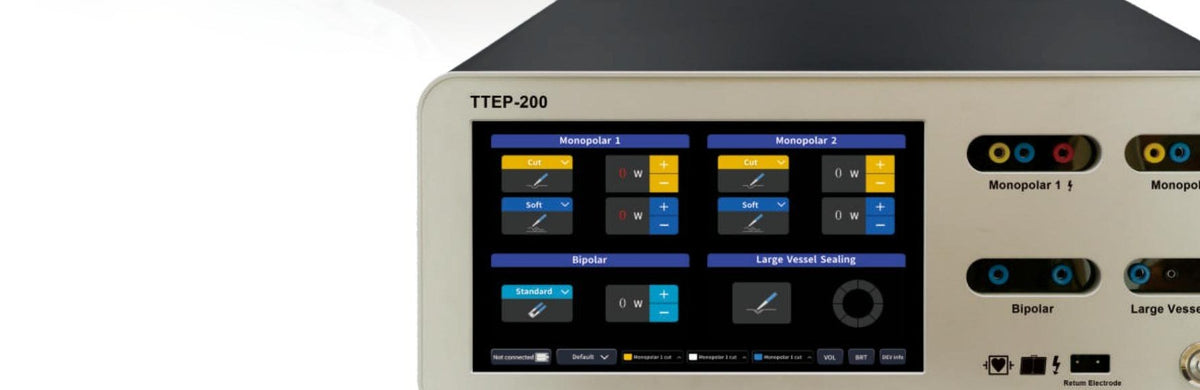
Chat on WhatsApp — instant replyThe TTEP-200 is a veterinary vessel sealing system that handles cutting and coagulation in both monopolar and bipolar, plus intelligent vessel sealing. It's built for soft tissue work in open and laparoscopic surgery on animals, and it seals and cuts vessels up to 7mm diameter safely.
PetMedTools supplies this veterinary electrosurgical unit quote-first. Send us your destination country and expected quantity and we'll issue a formal quotation with a proforma invoice.
Why 7mm matters
Vessel diameter is the spec that decides whether a sealing device belongs in your theatre or not. Below about 3mm, bipolar forceps handle most of what you meet. Above that, and especially in splenectomy, liver lobectomy or large-breed ovariohysterectomy, you're into territory where ligatures cost you time and sutures cost you confidence.
Seven millimetres covers the vast majority of what a small animal surgeon encounters. That's the practical read on the number.
One device, ten modes
The unit carries five cutting modes, three monopolar coagulation modes and two bipolar modes.
Cutting: Pure for rapid complete resection and fine resection of focal tissue. Blend 1 removes lesion tissue quickly with less bleeding at 70% cutting and 30% coagulation. Blend 2 balances at 50/50 for moderate rate resection. Blend 3 runs 30% cutting and 70% coagulation for slow removal with large bleeding. Intelligent Cutting is the mode where you stop setting parameters — the tissue adaptive algorithm identifies tissue status, adjusts output automatically, and optimises the cutting speed and coagulation effect.
Monopolar coagulation: Soft coagulation slowly heats tissue to increase heat penetration depth, which suits deep tissue coagulation where stability matters. Spot coagulation generates sparks through the air to achieve small precise coagulation of targeted tissue. Spray coagulation sparks over a wider sputtering range for coagulation across a larger tissue field.
Bipolar: Standard Mode works with bipolar scissors, bipolar forceps and similar instruments, so you can achieve cutting or coagulation without lower thermal damage concerns. Intelligent mode delivers more stable and accurate output through intelligent algorithms, for precise cutting or coagulation.
The sealing algorithm
Feedback runs at 450,000 times per second on large blood vessel sealing. Maximum power is 200W. The unit stops outputting energy and sounds an alarm automatically once a seal completes — you're not watching a timer.
The non-stick Curved Large Jaw cuts sealing time on blood vessels by 50% and reduces adhesion, eschar and thermal damage to adjacent tissues. Eschar on the jaw quietly drains your theatre time during a long procedure. Every time tissue sticks, you stop and clean.
Specifications
- Max power: 200W
- Vessel sealing diameter: up to 7mm
- Feedback algorithm: 450,000 times/sec
- Cutting modes: 5 (Pure, Blend 1, Blend 2, Blend 3, Intelligent Cutting)
- Monopolar coagulation modes: 3 (Soft, Spot, Spray)
- Bipolar modes: 2 (Standard, Intelligent)
- Standard sealer: TT-LA05 370mm or TT-LB13
- Compatible with LigaSure™ sealer of Covidien
- Return electrode monitoring system
- Power memory function
- Interactive touch screen
Instruments and consumables
The standard sealer is the TT-LA05 at 370mm, or the TT-LB13. TT-LA05 comes in a curved jaw version, with the TT-LXA05 as the straight jaw alternative. The TT-1201 is also listed in the range.
Covidien LigaSure compatibility is worth flagging if you already run that platform — it means your existing sealer stock isn't stranded when the generator changes.
Power memory and return electrode monitoring
Power memory means the unit remembers your settings between cases, so the surgeon who prefers Blend 2 at a particular output doesn't rebuild the setup every morning. Small thing, daily payoff.
Return electrode monitoring watches the patient plate. In monopolar work that's the safety layer that catches a partially detached pad before it becomes a burn. If you're adding monopolar capability to a theatre that has only run bipolar until now, this is the feature to understand properly before the first case.
Fitting it into your theatre
Electrosurgery changes what your anaesthesia and monitoring setup has to cope with. Longer, more complex procedures become viable, which shifts the load onto everything else in the room — the veterinary anesthesia machine buying guide and the veterinary patient monitor buying guide cover how to match those to a surgical caseload.
Oxygen delivery matters for the same reason, and the veterinary oxygen equipment buying guide works through supply options. Laparoscopic work brings its own equipment questions, which the veterinary endoscope buying guide addresses by species and scope diameter.
Sterilisation load goes up with reusable sealers, so plan that alongside the purchase — our sterilisation range lists the options. Surgical consumables and drapes sit in the veterinary clinic hygiene products buying guide, and the wider index is at the buying guides hub.
TTEP-200 or TTEP-100?
The manufacturer lists a TTEP-100 alongside this unit, and the published specifications sit unusually close together. Both are described as covering cutting and coagulation in monopolar and bipolar with intelligent vessel sealing. Both are stated as suitable for open and laparoscopic soft tissue surgery on animals. Both quote 200W max power, the same 450,000 times per second feedback algorithm on large vessel sealing, 7mm vessel capability, LigaSure compatibility, power memory and return electrode monitoring.
So what actually separates them? The catalogue doesn't say, and we won't invent a difference to justify a price gap. Ask us at quotation stage and we'll get the answer from the manufacturer in writing — configuration, accessory bundle and sealer compatibility are the usual places the difference lives. If someone tells you the higher model is simply "more powerful" without pointing at a number, treat that as a reason to keep asking.
Training and first cases
Intelligent modes reduce the parameter-setting burden, which shortens the learning curve for a team new to advanced electrosurgery. That's the honest upside. The flip side is that automatic output makes it easier to use the device without understanding what it's doing, and monopolar carries real risk when the return path isn't right.
Plan your first few cases as supervised ones. Confirm plate placement protocol, confirm which mode your surgeons default to, and confirm who is responsible for checking the sealer jaws between cases. Ten minutes of protocol now saves a complication later.
One more practical note on theatre setup: decide where the generator physically lives before it arrives. A trolley that has to be dragged between two theatres gets dropped, and the footswitch cable is usually the first thing to fail. Fixed position beats portable for a unit you'll use daily.
What to confirm before you order
The TTEP-200 is manufactured by TooToo MediTech Co., Ltd. Everything above comes from the manufacturer's published specification. Four things it can't tell you:
Market certification. Electrosurgical generators face registration requirements that vary by country. Tell us your destination early.
Power supply. Confirm your supply and phase against the installation requirement before the order goes in.
Sealer stock. Decide which sealers and how many at quotation stage. Instruments are the recurring cost, not the generator.
Service and warranty. Ask for warranty length and service arrangements in writing with the quotation. Get it on paper before payment.
Buying a TTEP-200
We work quote-first, so there's no price on this page. Send the models you're comparing, expected quantity, destination country and any certification, accessory or packaging requirements. We issue a proforma invoice against that, payment is by USD bank transfer — T/T, ACH or wire — and we ship once it clears.
Bulk pricing, distributor terms, OEM questions and region limits are settled at quotation. Comparing across categories? Start from the full product range.